The biggest novels in Prometheus history: An annotated list of the top dozen in page length (and why such epic works reward readers)


By Michael Grossberg

Size matters – or at least it can make a big difference, in helping a novel to achieve greater dramatic impact in its scope, depth, narrative complexity and emotional power.

Quite a few longer novels have been recognized by the Prometheus Awards over the past 47 years, whether as nominees, finalists or winners – from J.R.R. Tolkien’s The Lord of the Rings, Neal Stephenson’s Cryptonomicon and Ayn Rand’s Atlas Shrugged to the recent nomination of Sarah Hoyt’s three-volume No Mans Land for the next Prometheus Award for Best Novel.

The three classic and epic works by Tolkien, Stephenson and Rand rank No. 1, 2 and 3 in page length in the history of the Prometheus Awards – as detailed in previous Prometheus Blog articles about the three bestselling winners and No Man’s Land.

So what are all the Prometheus-recognized novels and their ranks in page lengths on our top-12 list?

Continue reading The biggest novels in Prometheus history: An annotated list of the top dozen in page length (and why such epic works reward readers)


The epic power and enduring appeal of the biggest Prometheus-honored novels: The Lord of the Rings, Cryptonomicon and Atlas Shrugged


By Michael Grossberg

Of the many novels that have won a Prometheus Award over the past 47 years and are still widely read today, a notable few have done so with the help of their longer length and epic scale.

From J.R.R. Tolkien’s The Lord of the Rings to Neal Stephenson’s Cryptonomicon and Ayn Rand’s Atlas Shrugged, size does matter in literature.

Or at least size can significantly enhance a novel, if the writers are experts and at the top of their game. If well-structured, well-paced and compelling enough to sustain the reader’s interest, longer novels can attract and retain the reader’s interest even through hundreds of pages.

Continue reading The epic power and enduring appeal of the biggest Prometheus-honored novels: The Lord of the Rings, Cryptonomicon and Atlas Shrugged


Does size matter? Sarah Hoyt’s unusual three-book novel No Man’s Land achieves epic scope yet is not unprecedented in literary history


By Michael Grossberg

Does size matter?

The question arises in fiction when authors conceive novels that are noticeably bigger in word count and longer in page length than usual.

In theory, a bigger novel makes possible a larger canvas, allowing for an epic scope, a more complex narrative, richer world-building, more full-bodied characters, greater subtleties and depths.

Whether or not ambitious authors fulfill that potential and achieve their literary goals when writing bigger novels varies, of course. So does whether readers will find it rewarding to invest the extra time needed to read such magnum opuses.

Such questions are interesting and timely to ponder now that Sarah Hoyt’s No Man’s Land has been nominated for the Prometheus Award for Best Novel.

Continue reading Does size matter? Sarah Hoyt’s unusual three-book novel No Man’s Land achieves epic scope yet is not unprecedented in literary history


A guide to Prometheus Awards voting: Check out our reviews of this year’s five Hall of Fame finalists by Blish, Lewis, Huxley, Roberts and Stross


By Michael Grossberg

As a guide to the Prometheus Awards and for the convenience of Libertarian Futurist Society members, the Prometheus Blog has once again published full-length and in-depth reviews of all of this year’s Prometheus Hall of Fame finalists for Best Classic Fiction.

Libertarian Futurist Society members, who have the right to vote to select the annual Best Classic Fiction winner from the finalists, are invited to read our reviews of the five novels selected as 2026 finalists – hopefully, to whet your appetite to read each finalist and vote in this year’s Prometheus Awards.

First published between 1932 and 2003, the five finalists were written by James Blish (The Star Dwellers), C.S. Lewis (That Hideous Strength), Aldous Huxley (Brave New World), Adam Roberts (Salt) and Charles Stross (Singularity Sky).

Other SF/fantasy fans and other libertarians, outside the LFS, also are invited to check out the reviews to better understand how they fit the distinctive dual focus of the Prometheus Awards on both quality and liberty.

Continue reading A guide to Prometheus Awards voting: Check out our reviews of this year’s five Hall of Fame finalists by Blish, Lewis, Huxley, Roberts and Stross


New generation of writers dominates this year’s 14 Prometheus nominations for Best Novel


By Michael Grossberg

Libertarian Futurist Society members have nominated 14 novels for the next Prometheus Award for Best Novel. Of those, nine nominees were written by authors nominated for the first time for a Prometheus Award.

With so many authors new to our awards, the Prometheus Awards may be entering a more hopeful period in which a new generation is writing science fiction, fantasy and other fantastical works informed by a clear awareness of the dangers of tyranny and the benefits of freedom.

The “new” Prometheus-recognized writers include Max Harms, Andrew Knighton, John C. A. Manley, Ewan Morrison, Laura Montgomery, Ray Nayler, J. Kenton Pierce and David A. Price.

Nominated again are three Prometheus-winning authors – Dave Freer (Cloud-Castles), Sarah Hoyt (Darkship Thieves) and Harry Turtledove (The Gladiator) – and one writer, Karl K. Gallagher, whose works often have become Best Novel finalists. In addition, writer R.H. Snow has been nominated several times for Best Novel.

Continue reading New generation of writers dominates this year’s 14 Prometheus nominations for Best Novel


Investigative journalist Matt Taibbi inspired by Bradbury’s Prometheus-winning novel to create “Project 451”


By Michael Grossberg

One of the many Prometheus-winning works that continues to be widely read and referenced in popular culture for its enduring dramatic power and themes is Fahrenheit 451.

Inducted in 1984 into the Prometheus Hall of Fame, Ray Bradbury’s civil-libertarian, anti-censorship and pro-reading novel envisions a dystopian future in which “firemen” burn books and literacy is suppressed, along with any memory of great literature.

While many find the novel relevant to our era, in which both free speech and the reading of books often seem threatened or in decline, few go as far as investigative reporter and media critic Matt Taibbi or as fervently.

Continue reading Investigative journalist Matt Taibbi inspired by Bradbury’s Prometheus-winning novel to create “Project 451”


Travis Corcoran is writing several Young Adult novels, including two for his Prometheus-winning Aristillus series


By Michael Grossberg

Two-time Prometheus Awards-winning author Travis Corcoran, a passionate believer in encouraging younger generations to read, is writing several Young Adult novels that promise to be published in 2026.

Two will be part of Corcoran’s Aristillus series, set in our solar system’s future and launched with his two Prometheus-winning novels The Powers of the Earth and Causes of Separation.

Tentatively set for publication this fall by Morlock Publishing, Corcoran’s two Aristillus YA novels are The Aristillus Engineering Club and the Journey to the Center of Mars and The Aristillus Engineering Club Around Mars in 80 Sols.

Continue reading Travis Corcoran is writing several Young Adult novels, including two for his Prometheus-winning Aristillus series


The Prometheus Awards and the Forry award for lifetime achievement: Cherryh, Anderson, Heinlein, Pratchett, Ellison among 13 authors recognized by both


By Michael Grossberg

Just as the Prometheus Awards overlaps to some extent with the Hugo and Nebula wards in terms of the works and writers recognized, our list of Prometheus-winning writers overlaps with the Forry Awards.

C.J. Cherryh, who co-wrote the 2020 Prometheus Best Novel winner (Alliance Rising) with her partner Jane S. Fancher, is the 13th Prometheus winner to also be recognized in the Forry awards.

C.J. Cherryh (File photo)

Cherryh recently won the 2025 Forrest J Ackerman Award for Lifetime Achievement given by the members of the Los Angeles Science Fantasy Society. (See our previous post about Cherryh’s latest honor.)

It’s interesting to see what writers have been recognized by both the LASFS, the world’s oldest continuously active science fiction and fantasy club, and the Libertarian Futurist Society (LFS), established in 1982 to sustain the Prometheus Awards.

Such broad cross-recognition should be another reminder of just how embedded libertarian and anti-authoritarian ideas and values are within our popular culture – and have been, for generations, even amid various socio-economic developments and political trends, both positive and negative.

So if Cherryh is the 13th Prometheus winner to be recognized with a Forry award, who else is on that illustrious cross-checked list?

Continue reading The Prometheus Awards and the Forry award for lifetime achievement: Cherryh, Anderson, Heinlein, Pratchett, Ellison among 13 authors recognized by both


Prometheus winner C.J. Cherryh recognized with the “Forry” lifetime achievement award

By Michael Grossberg

C.J. Cherryh in the 1990s (File photo)

Congratulations to C.J. Cherryh for her latest well-deserved honor.

Cherryh, who co-wrote the 2020 Prometheus Best Novel winner (Alliance Rising) with her partner Jane S. Fancher, is the winner of the 2025 Forrest J Ackerman Award for Lifetime Achievement given by the members of the Los Angeles Science Fantasy Society.

The Forry Award, as it’s known informally, is Cherryh’s fourth career honor, according to a news note in File 770, a leading publication covering the sf/fantasy field.  She was named a SFWA Grand Master in 2016 from the Science Fiction Writers Association, received the Skylark Award from the New England Science Fiction Association in 1988, and the Robert A. Heinlein Award from our friends in the Heinlein Society in 2021.

Continue reading Prometheus winner C.J. Cherryh recognized with the “Forry” lifetime achievement award

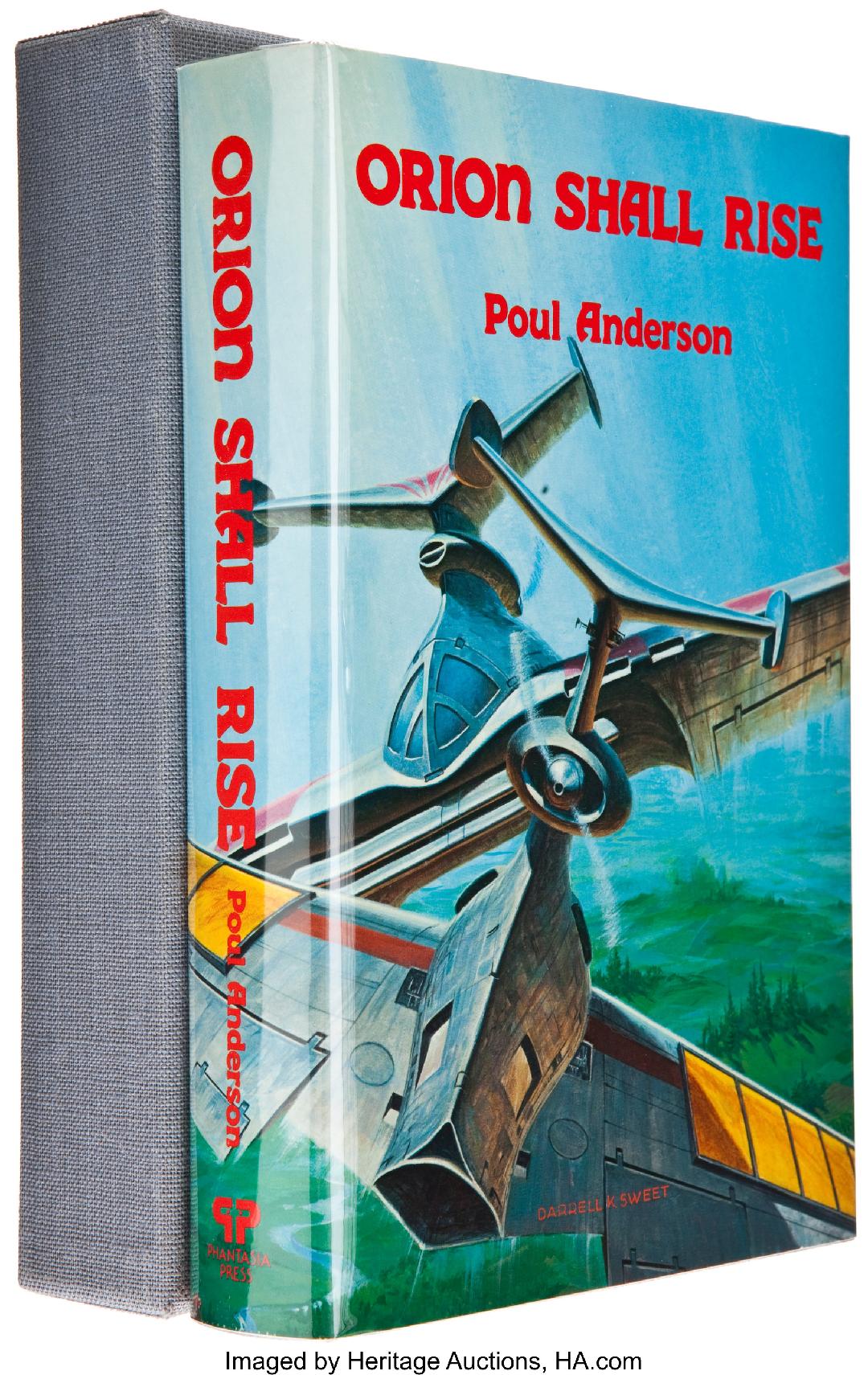
Power myths, clashing cultures and the necessity of freedom: The first Prometheus review of Poul Anderson’s “brilliant” Orion Shall Rise


By Michael Grossberg

With Poul Anderson’s Orion Shall Rise inducted most recently into the Prometheus Hall of Fame for Best Classic Fiction, it’s interesting to look back on our initial review of the 1983 novel for its insights and first impressions.

Victoria Varga, the first LFS Director and editor of the print edition of Prometheus from 1983 to 1988, reviewed Anderson’s science fiction novel when it was first nominated for a Prometheus Award for Best Novel.

Thanks in part to her positive review, Orion Shall Rise was selected by Libertarian Futurist Society members as a 1984 Best Novel finalist (the year that J. Neil Schulman’s The Rainbow Cadenza won our award.)

Most notably, Varga praised Anderson for doing “a brilliant job of creating mythologies, religious and secular, for his characters and their civilizations.”

Continue reading Power myths, clashing cultures and the necessity of freedom: The first Prometheus review of Poul Anderson’s “brilliant” Orion Shall Rise